CHIEF SCIENCE OFFICER
Professor Jane Ridley
Cognitive systems · Degenerative cognition · Retained identity structures

A private research and policy organisation focused on cognition, biological decline, and resilience systems.
Operate beyond individual careers, funding cycles, and public fashion.
Preserve intelligence, empathy, memory, and decision-making capacity as linked inheritances.
Separate public-facing scholarship from sensitive applied development.
Public material focuses on neural modelling, biological substrates, materials systems, cellular repair, and resilience infrastructure.
 Neural modelling
 Adaptive substrate systems
 Materials and interface research
 Cellular repair and maintenance
The Society’s executive echelon establishes long-term direction. Second-echelon offices operate within specialised research domains under controlled information boundaries.
The central triad is designed to separate operational authority from mandate review, ensuring that research remains aligned with the Society’s founding purpose while limiting uncontrolled disclosure across sensitive programmes.
Peripheral domains are arranged as controlled offices rather than public departments. Each office maintains its own research protocols, infrastructure permissions, and archival restrictions.
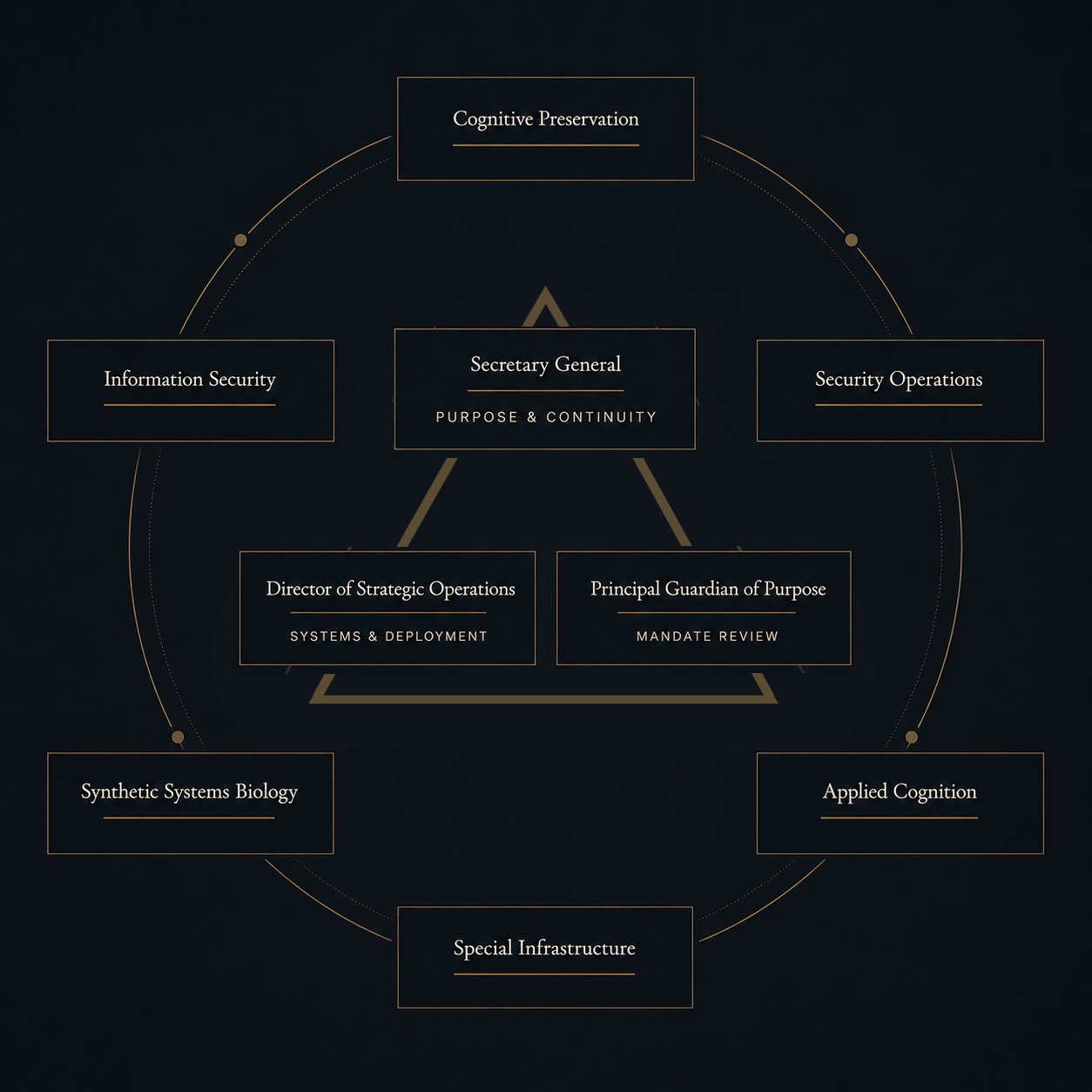
Public-facing appointments and controlled disclosure profiles.
Cognitive systems · Degenerative cognition · Retained identity structures
Compartmentalised systems · Cryptographic isolation · Restricted environments
Controlled access · Facility integrity · Personnel movement protocols
Neural substrates · Cellular repair · Adaptive interfaces
Comparative reasoning · Inference systems · Learned behaviour models
Research infrastructure · Operational resilience · Transport interfaces
Record access requires authorisation as applied work moves toward restricted integration.
Foundational paper establishing measurable markers of behavioural continuity during cognitive decline.
Early work on machine-mediated consent preservation under unstable cognitive conditions.
Preliminary modelling of cognition beyond biological substrate dependence.
Internal research into continuity degradation under external recognition pressure.
Final public-facing publication before transition to closed archival circulation.
With effect from 2029, publication under the Society's name is discontinued. Records are retained in restricted archival circulation. Requests for access are reviewed manually. Request credentials
Selected archives, research materials, and internal publications remain unavailable through the public index.
Access requests are reviewed manually. Submission does not guarantee credential approval.